USCIS Translation Requirements
Everything you need to know to get your translation accepted by USCIS on the first try.
Quick Answer
USCIS requires Certified Translation with a Certificate of Accuracy. This means a professional human translator must translate every word and sign a statement certifying the translation is complete and accurate. Notarization is NOT required.
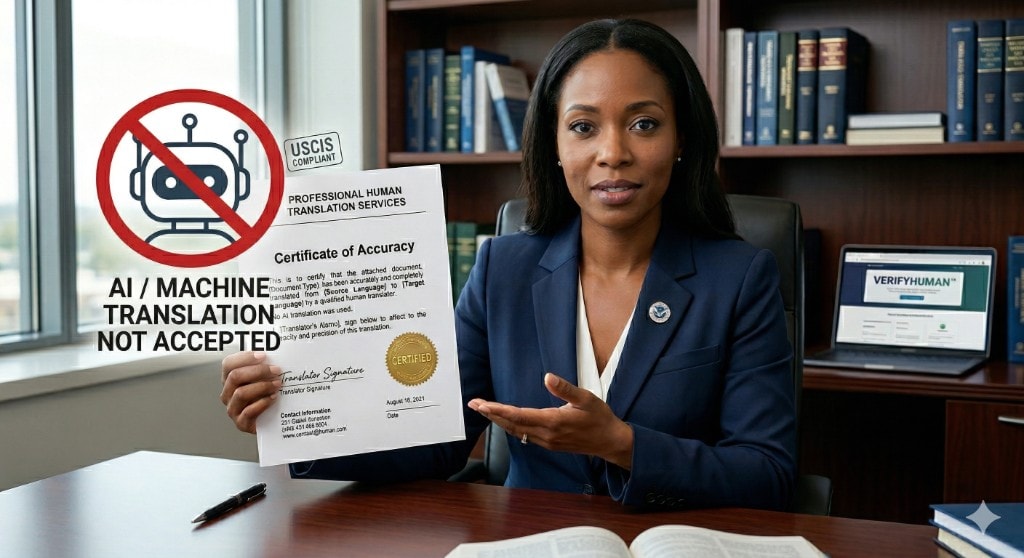
USCIS requires a Certificate of Accuracy from a professional human translator. AI and machine translations are not accepted.
What USCIS Accepts
Quick reference for translation requirements
| Translation Type | USCIS Accepts? | Notes |
|---|---|---|
| Professional human translation | Yes | Required for all foreign documents |
| Machine/AI translation (Google, ChatGPT) | No | Not accepted |
| Self-translated documents | No | Even if bilingual |
| Family member translation | No | Third-party required |
| Certificate of Accuracy | Yes | Must be signed and dated |
| Notarization | Optional | Not required, but accepted |
| Partial translation | No | Every word must be translated |
Note: Even if you're fluent in both languages, USCIS will not accept self-translated documents. A third-party professional translator is always required.
The Certificate of Accuracy
This is the most important document in your translation package. Without it, USCIS will reject your translation—no matter how accurate it is.
Certificate of Accuracy
I, [Translator Name], certify that:
The attached translation from [Source Language] to English is a true and accurate translation of the original document.
I am competent to translate between these languages.
Included free with every order
Top 5 Rejection Reasons
Avoid these mistakes and your translation will be accepted
Missing Certificate of Accuracy
35% of rejectionsThe #1 reason. Without this signed document, USCIS will reject your translation automatically.
Incomplete Translation
25% of rejectionsStamps, seals, or sections left untranslated. Every element must be included.
Machine/AI Translation
20% of rejectionsGoogle Translate, ChatGPT, etc. are not accepted—even if reviewed by a human.
Self-Translation
15% of rejectionsYou cannot translate your own documents, even if you're bilingual.
Missing Credentials
5% of rejectionsCertificate not signed, dated, or missing translator information.
Skip the stress. Get a USCIS-compliant translation.
Start OrderUSCIS Acceptance Checklist
Check each item to verify your translation is ready
Check all items to verify your translation is USCIS-ready
Do I Need Notarization?
Answer a few questions to find out
What is this translation for?
Frequently Asked Questions
About the Author
Lead Certified Translator
Maria is a certified translator with over 12 years of experience specializing in immigration and legal documents. She has helped thousands of clients successfully submit translations to USCIS and other government agencies.
You might also find helpful
Certified vs Notarized Translation
Learn when you need certification, notarization, or both.
K-1 Fiancé Visa Translation Guide
Complete document checklist for K-1 visa applications.
Common Translation Mistakes
Mistakes that lead to rejections and how to prevent them.
99.9% USCIS Acceptance Rate
Ready for Your USCIS Translation?
Certificate of Accuracy included. Fast delivery. Guaranteed acceptance.